
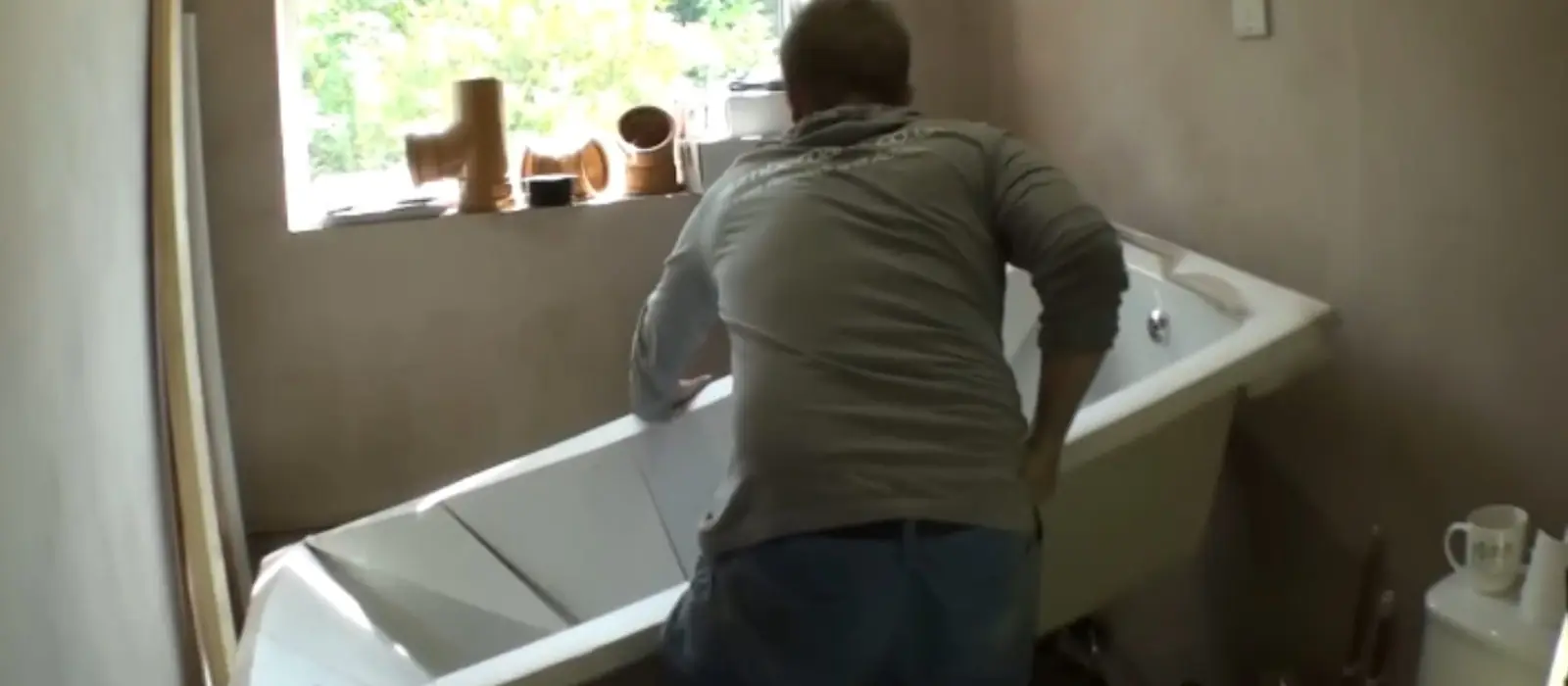
The parts of a tub installation
The drain assembly connects the tub to the trap. It includes a shoe at the bottom, a tailpiece and an overflow pipe that catches water if the tub fills too high. The trap is a curved pipe that holds a seal of water to stop sewer gas from coming up. The trap connects to the branch drain, which meets the vent so that water can flow without gurgling.
On the supply side, the valve sits in the wall behind the tub. Cold and hot lines connect to it, and a spout and shower arm connect to the other end. Today most valves are single-handle pressure balancing or thermostatic types, which keep the shower from scalding when someone flushes a toilet.
| Part | Job | Common problem |
|---|---|---|
| Drain shoe and strainer | Connects the tub to the tailpiece | Leak from a dry or cracked seal |
| Overflow pipe | Catches high water | Gasket leak under the overflow plate |
| Trap | Holds a water seal | Dry or slow draining |
| Vent | Lets air into the drain line | Gurgling, slow drain |
| Mixing valve | Blends hot and cold | Temperature swings, drips |
| Spout and diverter | Directs water to tub or shower | Diverter stuck, leak behind the wall |
Rough-in: what has to line up
Checks a plumber makes before the tub goes in
- The drain center matches the tub's drain location.
- The floor is level and strong enough for a full tub.
- The trap and vent connect to the branch drain with the right slope.
- The valve is at the right height and depth for the finished wall.
- There is an access panel where code or the manufacturer calls for one.
- The supply lines are pressure tested before walls are closed.
Slope matters. A drain line that is too flat holds water and grows biofilm and clogs. One that is too steep can let water run ahead of waste. A plumber sets the slope to the code and then tests with water to confirm the drain is clear.
Installing a drop-in or alcove tub, simplified
- Turn off water, remove the old tub if there is one and inspect the subfloor.
- Check the drain location and set the trap and tailpiece.
- Dry-fit the tub and mark the drain hole position, then set it on a mortar bed or the maker's support.
- Attach the drain shoe and overflow with new gaskets and plumber's putty or silicone as the maker directs.
- Connect the trap, run a test and then connect the valve, spout and shower arm.
- Run water for fifteen minutes and look for leaks before any wall is closed.
Older Alhambra bathrooms
Houses from the 1930s and 1940s in tracts such as Mayfair and Bean often have original cast iron tubs and galvanized supply lines. Removing a heavy cast iron tub takes two people and care for the floor. If the supply lines are galvanized, it is a good time to talk about repiping while the walls are open.
Choosing the tub and the drain
Tubs come in acrylic, fiberglass, enameled steel and cast iron. Acrylic and fiberglass are light and warm to the touch. Steel is thin and can be noisy. Cast iron holds heat and lasts for decades but weighs several hundred pounds, so floor support and a helper matter.
Drains come as trip lever, lift and turn, push to close and toe-touch types. The overflow and the stopper mechanism sit behind the tub wall or under the tub, so pick one that you can reach through an access panel. A drain that can only be serviced by cutting tile is a poor choice.
Questions to settle before the tub is ordered
- Does the tub's drain location match the existing line, left, right or center?
- Will the doorway and stairs allow a cast iron or large acrylic tub through?
- Is there a place for an access panel behind the plumbing wall?
- Does the floor need reinforcing?
- Are you changing the valve, so the wall must be opened anyway?
Test before you close up. Fill the tub to the overflow, release it and watch every joint and the trap for drips. Run the valve at full flow and check the wall side for seepage. Leave the access panel open overnight if you can, and look again in the morning for damp spots.
Alhambra rules for new or changed plumbing
The City of Alhambra adopted the Los Angeles County plumbing code in Chapter 20.11 of its municipal code, which is based on the 2022 California Plumbing Code. Ask the City at (626) 570-5007 whether a tub replacement, a relocation or a new bathroom needs a permit.
According to the City's 2024 water quality report, groundwater hardness is 202 ppm. Hard water leaves scale on a tub spout and valve cartridge, so choose a valve that can be serviced from the front and plan to clean the aerator and diverter.
Source type: Alhambra Municipal Code Chapter 20.11 and the City of Alhambra's 2024 water quality report.
What shapes the price
Tub plumbing installation pricing depends on:
- Swap or relocation
- Replacing a tub in place is far simpler than moving it.
- Drain and vent condition
- Old or undersized lines may need replacing.
- Valve type
- Thermostatic valves cost more.
- Wall and floor access
- Tile, slab and attic access affect labor.
- Permit
- New work may need a permit and inspection.
You get a clear price before work starts. Installation is planned work, so emergency rates do not apply.
If you also plan a new toilet or sink, see toilet repair and installation. We serve remodels in Alhambra and in South Pasadena and Monterey Park.
Questions about bathtub plumbing
Often yes, if you can reach the underside through an access panel. Use the right gaskets and test for leaks.
A swap in the same place takes a day or two, depending on the surround. A new rough-in takes longer.
Yes. The trap needs a vent so that it drains smoothly and does not siphon.
Check the slope, the vent and the trap. A plumber can camera the line.
Ask the City of Alhambra at (626) 570-5007, because it depends on the work.
Have a plumbing problem right now? A dispatcher answers around the clock.
☎ Call (626) 898-6169