
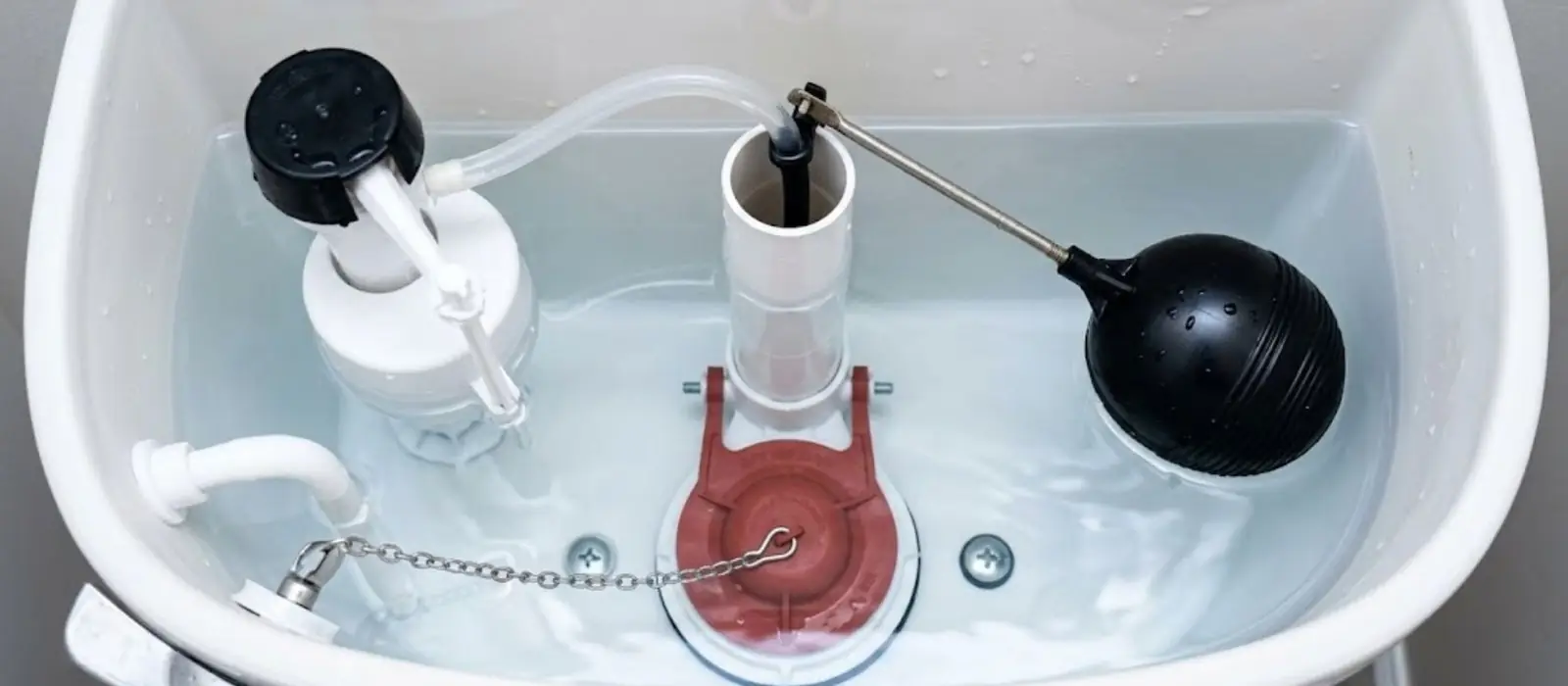
Find out which kind of leak you have
Tank leaks fall into two groups. Internal leaks send water from the tank into the bowl without a flush, and you hear the toilet refill every so often. External leaks put water on the floor, and they are more urgent because they damage the floor and subfloor.
Dry the outside of the tank and the supply line with a paper towel, then watch for drops. Check where the supply line meets the shutoff valve, where it meets the tank and where the two tank bolts pass through the bottom. The drop that appears first tells you where to look.
| Symptom | Cause | Fix |
|---|---|---|
| Toilet runs or refills on its own | Worn flapper or chain length | Replace flapper, adjust chain |
| Water trickles into the overflow tube | Fill valve set too high or failing | Adjust or replace fill valve |
| Drip at the supply line | Loose or worn connection | Tighten or replace the line |
| Water at tank bolts | Failed rubber washers | Replace bolts and gaskets |
| Water between tank and bowl | Failed spud gasket | Replace gasket |
| Cracks in the tank | Age or impact | Replace the tank or toilet |
The dye test and the quick fixes
Test and fix a running or leaking tank
- Close the shutoff valve to pause the refill, then open it again when you are ready.
- Add food coloring to the tank water and do not flush for fifteen minutes.
- If color reaches the bowl, replace the flapper. Match the shape to your toilet model.
- If water is running into the overflow tube, lower the float or replace the fill valve.
- If the leak is outside the tank, tighten the connection a quarter turn and test. Do not over-tighten porcelain.
Signs to stop DIY and call a plumber
- The supply line or shutoff valve will not stop dripping.
- The shutoff valve will not turn.
- The floor around the toilet is soft or stained.
- The tank has a crack.
- You see rust or corrosion at the fittings.
- The toilet is over twenty years old and keeps leaking.
A toilet that rocks, or leaks at the base, has a different problem from the tank. That points to the wax ring or the flange, and the toilet must be lifted to fix it. See toilet repair for that job. If the shutoff valve will not stop a spray, faucet and valve repair covers valve replacement.
How much water is a running toilet wasting?
A constantly running toilet can waste a large amount of water over a day, and the amount depends on the leak. It is also the easiest leak to fix, so do it soon. If the meter moves with all fixtures off, check the toilets first, then ask a plumber to run a pressure test on the rest of the house. See leak detection for how that works.
Parts last longer than people expect, but not forever
Flappers are rubber and wear in a few years. Fill valves have plastic parts and seals. Supply lines are often braided steel and last longer, but the rubber washers inside them age. When you replace one part in a toilet older than fifteen years, ask whether the others should be replaced at the same time.
Replacing a flapper or a fill valve, step by step
A basic tank repair
- Close the shutoff valve, flush to empty the tank and sponge out the last water.
- For a flapper, unhook the chain and lift the old flapper off its pegs. Clip the new one on, set the chain with about half an inch of slack and test.
- For a fill valve, disconnect the supply line, unscrew the nut under the tank, lift the old valve out and set the new one at the height the maker marks.
- Tighten by hand plus a quarter turn, reconnect the supply line and open the valve slowly.
- Flush three times and watch for drips at every joint.
Take the old part with you when you buy a new one. Flappers come in several sizes and shapes, and a close match is not always a working one. Universal parts can work, but check that the fit is snug and that the flapper falls fully on its seat. A chain that is too tight holds the flapper open, and one that is too loose can get caught under it.
Keep the receipt and write the date on the tank lid with a pencil. Knowing when a part was last changed saves guesswork the next time the toilet runs.
Alhambra water and rubber toilet parts
According to the City of Alhambra's 2024 water quality report, chlorine is the disinfectant and total hardness is 202 ppm in groundwater and 272 ppm in imported water. Scale from hard water can stick to the flapper seat and keep it from sealing, so cleaning the seat is part of a good repair.
The report does not mention chloramine. Chlorine can age rubber parts over time. Ask the City of Alhambra Utilities Department at (626) 570-5061 if you want to know which supply serves your street.
Source type: the City of Alhambra's 2024 annual water quality report (municipal utility report).
What shapes the price
Toilet tank repair pricing depends on:
- Part
- A flapper is inexpensive. A tank and bowl set costs more.
- Parts matching
- Older toilets may need special parts.
- Water shutoff
- A stuck valve adds work.
- Time of day
- Night calls cost more.
- Replace or repair
- A cracked tank is usually replaced.
You get a clear price before work starts.
We repair toilets across Alhambra and in Monterey Park and San Marino.
Questions about toilet tank leaks
That is called phantom flushing. The flapper is letting water seep into the bowl, so the fill valve tops up the tank.
It is better not to. Strong chemicals can damage the flapper and rubber parts.
Most tank repairs take under an hour. A toilet reset takes longer.
Only if the tank is cracked or the toilet is old and failing. Most leaks are a part.
It can contribute. The City's 2024 report lists 202 ppm and 272 ppm hardness, and scale can stop a flapper from sealing.
Have a plumbing problem right now? A dispatcher answers around the clock.
☎ Call (626) 898-6169