
What changes when you go tankless
A tank heater stores forty to fifty gallons and keeps it hot. A tankless unit heats water as it passes through a heat exchanger. When you open a tap, flow sensors start the burner or the elements, and the water comes out at the set temperature as long as the unit can keep up with the flow.
That sounds simple, but the house has to support it. Gas models need a gas line large enough for a bigger burner, often with a larger meter or pipe size. They also need venting, and many need a condensate drain. Electric models need heavy circuits that some panels cannot supply without an upgrade.
| Factor | Tank heater | Tankless heater |
|---|---|---|
| Hot water supply | Limited by tank size, then recovery | Continuous, limited by flow rate |
| Upfront cost | Lower | Higher, often with gas or electrical upgrades |
| Space | Large footprint | Wall mounted, smaller |
| Lifespan | Often 8 to 12 years | Often longer with maintenance |
| Maintenance | Drain sediment yearly | Descale heat exchanger yearly in hard water |
| Power outage | Gas tank without a fan may still work | Needs electricity to run |
Sizing the unit
Sizing is about flow and temperature rise. Add up the flow rates of fixtures you might run at once, such as a shower and a dishwasher. Then check the incoming water temperature. Colder incoming water means the unit has to work harder to reach the same output. A plumber uses both numbers to select a model.
Undersized units are the main complaint. If two showers run and the unit cannot keep up, the water turns lukewarm. Larger households sometimes install two units or pick a higher capacity model.
Before you decide
- Is the gas line large enough, and is there room for a new vent?
- Is there a drain nearby for condensate and the relief valve?
- How many fixtures will run at once?
- What will happen to the old tank vent opening?
- Will the panel handle an electric unit?
- What does the warranty cover on the heat exchanger?
Hard water is the maintenance issue
Scale builds on the inside of the heat exchanger, restricts flow and cuts efficiency. In hard water areas, tankless makers recommend regular descaling, usually once a year. A softener or scale reducer upstream can extend the interval. Skipping the flush is the most common reason tankless units fail early.
If you are choosing between tank and tankless, factor the maintenance into your decision. Our water softener and filtration page explains your options, and water heater installation covers the standard tank route.
What to expect on install day and after
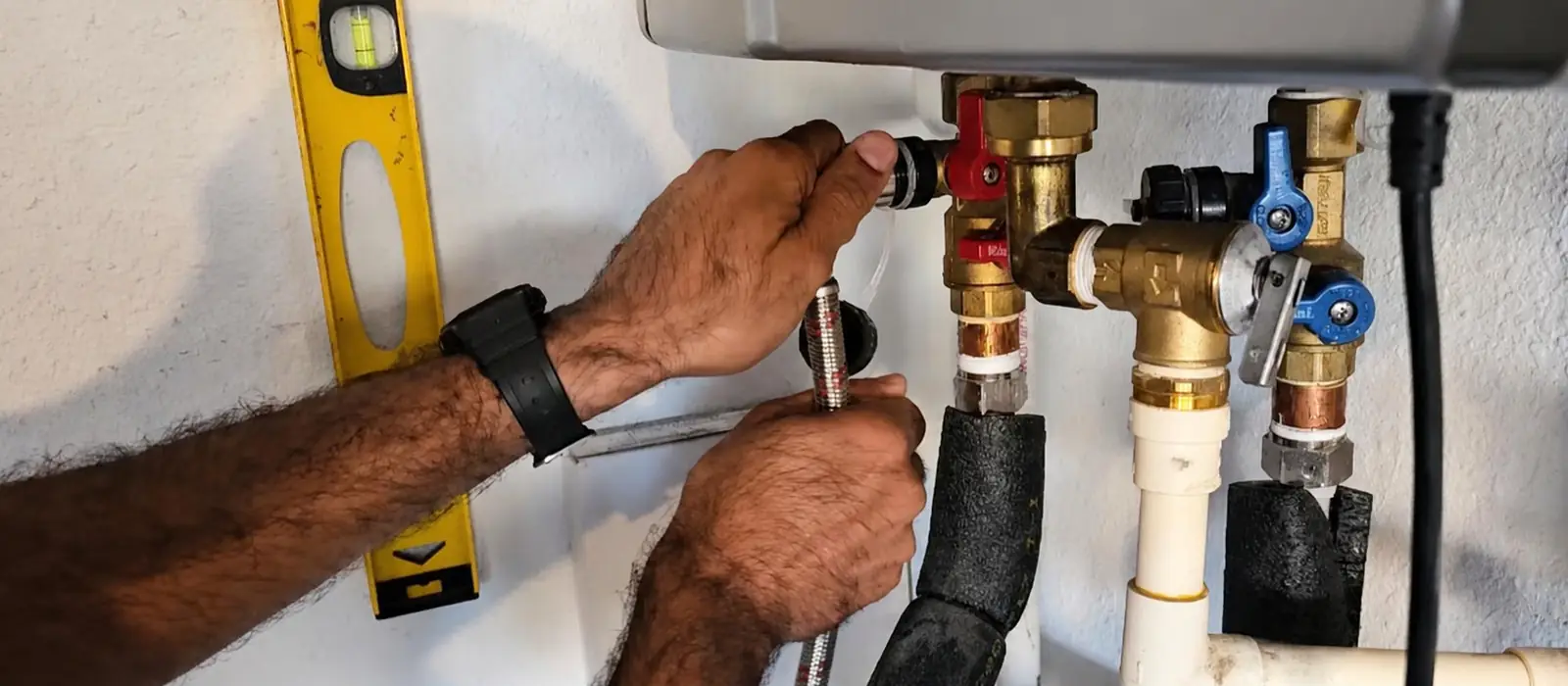
Plan on most of a day. The plumber removes the old tank, mounts the new unit on the wall, ties into water, gas or power, runs the vent and condensate line and installs service valves for flushing. The system is tested at several flow rates, and the plumber sets the temperature and shows you the controls.
Expect two quirks. Tankless heaters need a minimum flow to fire, so a barely open tap may run lukewarm. And the delay for hot water to arrive at a far bathroom is the same as before, because the heater only changes where the water is heated. A recirculation pump can shorten the wait.
Yearly care for a tankless heater
- Flush the heat exchanger with a descaling solution, following the maker's steps.
- Clean the inlet water filter screen.
- Check the vent and condensate drain for blockages.
- Look for error codes and write them down.
- Test the pressure relief valve if the model has one.
If you rent or share a building, ask the owner or the board before changing the heater. Gas load and venting affect neighboring units in some buildings, and approvals take time.
Alhambra water: hardness figures to plan around
The City of Alhambra's 2024 water quality report shows total hardness of 202 ppm in local groundwater and 272 ppm in imported Metropolitan water, as calcium carbonate. Dividing by about 17 gives roughly 12 and 16 grains per gallon. The report also mentions water softening as an option for reducing calcium carbonate buildup in the hot water system.
About 70 percent of the supply is groundwater and 30 percent is imported, so the mix at your tap can vary. For Alhambra's permit and inspection rules, ask the City at (626) 570-5007, and note that the City adopted the Los Angeles County plumbing code in Chapter 20.11 of its municipal code.
Source type: the City of Alhambra's 2024 water quality report and Alhambra Municipal Code Chapter 20.11.
Is it worth it?
Tankless pays back slowest for small households that use little hot water and fastest for larger households that run a lot of it. Savings depend on gas or electric rates and on use, and we do not promise a number. If your current tank is nearing the end of its life, a quote for both options is the fair comparison.
What shapes the price
Tankless replacement pricing depends on:
- Unit and capacity
- Higher output models cost more.
- Gas line and venting
- Upgrades are common.
- Electrical
- Electric units may need a panel upgrade.
- Descaling kit
- Service valves make flushing easy.
- Removal
- Taking out the old tank adds labor.
You get a clear price before work starts. Installation is planned work, so emergency rates do not apply.
We install and service tankless heaters in Alhambra and nearby, including Monterey Park and South Pasadena.
Questions about tankless water heaters
It can be, especially for larger households. Weigh the higher install cost and yearly descaling against the longer lifespan and the space saved.
Yes, with maintenance. The City's 2024 report shows 202 and 272 ppm hardness, so plan on a yearly flush and consider a softener.
It involves gas, venting and electrical work, and a permit. A licensed plumber should do it.
Typically a day, longer if the gas line or vent needs work.
Sometimes. A plumber calculates the load before quoting.
Have a plumbing problem right now? A dispatcher answers around the clock.
☎ Call (626) 898-6169